






















Game News

Cosmic Adventure: Escape with Your Spaceman
Game Introduction In the vast and lonely universe, an astronaut has lost contact with their companions and fallen into an unprecedented predicament. Your mission is to guide this helpless space traveler to find key items in the dangerous environment, unlock the escape door, and regain safety. Please note that there are deadly electric current traps hidden in the universe. Once you touch them, all your efforts will be reset instantly, and you have to start the challenge from the beginning. Only when you find the glowing portal can you truly reach the target and pass the level successfully. This battle against the universe has begun—are you ready to take on this ultimate escape challenge? Game Features 1. Clear Core Goal: Find the key, open the escape door, and guide the astronaut to survive the cosmic escape. 2. Distinct Risk Mechanic: Touching the electric current trap resets the level immediately, testing your operation and planning skills. 3. Obvious Clear Signal: Locating the portal means achieving the goal, providing quick feedback on level completion. 4. Strong Scene Immersion: Set against the vast and lonely universe, enhancing the sense of engagement in the space escape. 5. Easy-to-Learn Gameplay: No complicated operation barriers, focusing on the core experience of "avoiding risks + achieving goals". Gameplay and Controls 1. Basic Operations Movement Control: Tap and drag any position on the screen to guide the astronaut moving toward the target direction; or use the direction keys for precise movement control. View Adjustment: Pinch in/out to zoom the view; swipe the screen to rotate the view and observe the scene. 2. Core Interactive Operations Obtain the Key: When the astronaut approaches the key, a "Pick Up" prompt will appear on the screen. Tap the prompt button to get the key. Open the Escape Door: Carry the key and approach the escape door. An "Unlock" icon will appear on the door. Tap the icon to open the door. Enter the Clear Portal: Guide the astronaut to walk into the glowing portal, and the clear animation will be triggered automatically with no additional operations needed. 3. Risk Avoidance Operations The flashing electric current areas in the scene are deadly traps, which can be avoided through the following operations: Observe the current pattern: The electric current shows a cycle of "flashing - static - bursting". You can pause movement to observe its pattern. Quick pass skill: During the static interval of the electric current, press and hold the movement button to make the astronaut pass through the trap area quickly and avoid staying. 4. Quick Operation Tips Level Reset: If you accidentally touch the trap, the system will reset automatically; you can also tap "Restart" in the settings interface to reset manually. Game Pause: Tap the "Pause" icon in the upper right corner of the screen to pause the game and view the operation guide. Game Guide Centered on "space escape", Spaceman Escape Adventure combines puzzle-solving and operational challenges. Many players get stuck on electric current traps and key-finding. This guide will help you quickly grasp the essence of clearing levels from basic logic to advanced skills, easily leading the astronaut out of danger. First, clarify the core level-clearing logic: the core link of each level is "locate the key → avoid traps → unlock the door → reach the portal", and all operations must balance "efficiency" and "safety". A common mistake for beginners is moving blindly and wasting time. In fact, the key, traps and door in each level have a fixed layout connection, so the 3-second observation at the start is crucial. It is recommended to rotate the perspective to scan the entire scene at the beginning, mark the glowing key point and electric current trap area, and plan the shortest route from "obtaining the key to reaching the door" to avoid turning back halfway.Obtaining the key and avoiding traps are the keys to clearing early levels. The key is usually hidden in slightly off-angle positions in the scene, such as equipment shadows or platform corners, but it will emit a faint blue light. You can quickly locate it by paying attention to the light source when rotating the perspective. If the key is surrounded by multiple electric current traps, do not rush through. First, stand in a safe area to observe the trap pattern—ordinary traps cycle through "3 seconds of flashing + 2 seconds of stillness", while elite level traps shorten the still time to 1 second and may have cross traps. For ordinary traps, you can press and hold the movement button to pass quickly during the still period; for cross traps, you need to find the overlapping period of the still intervals of the two traps (usually 1.5 seconds apart) and pass through in one go after prediction. There are skills for unlocking the door and dashing to the portal. After getting the key, the door position will flicker slightly on the map. At this time, you need to note that some levels have "hidden traps" near the door—electric current areas that do not flicker but trigger when approached. Move slowly when passing by, and stop immediately if a red warning appears on the edge of the screen. After opening the door, the portal will activate and glow. At this time, you need to distinguish between "safe dash" and "risky dash": if there are no traps along the way, you can dash directly to the portal; if there are remaining traps, you must pass through according to the original avoidance logic to avoid ruining all previous efforts. Use advanced strategies to deal with high-difficulty levels. As levels progress, "moving traps" and "multiple keys" mechanisms will appear. Moving traps patrol along fixed paths. To deal with them, observe their movement cycle and pass through the gaps in the path. If necessary, use perspective zoom to accurately judge the distance. For multi-key levels, pick up keys according to the "nearest principle"—get the key closest to your current position first, then the others in sequence to avoid detours. If you accidentally touch a trap and reset the level, don't panic. Use the 3-second invincibility period after the system resets to rush directly to the nearest key, which can save time on re-planning.Finally, share practical tips: the pause function not only allows you to rest, but also freezes the screen to observe trap patterns in complex scenes; if you fail multiple times in the same area, zoom the perspective to the maximum to clearly see the trap boundaries. After mastering the above skills, you only need to maintain calm observation and precise operation to make every space escape easy and clear all levels quickly.
Calm Word Quest: Daily Crossword Challenges
Game Introduction It’s more than just a crossword; it’s a "brain charging station" that lets you have fun while relaxing! You don’t need complicated operations here. Just slide your finger to connect letters and form meaningful words. Whether you string letters horizontally or combine them vertically, every successful spelling brings a great sense of accomplishment. As you progress through the levels, you’ll not only unlock more fun in over 1,000 challenging levels but also unconsciously improve your spelling skills and expand your vocabulary, keeping your brain active. What’s more, there are free hints available in the game, and you can earn bonus coins by completing tasks. This lets you easily get through stuck levels and enjoy the pure fun of word puzzles. Game Features 1. Simple controls:Slide to connect letters and form words, with both horizontal and vertical combinations supported. 2. 1000+ challenging levels, with increasing difficulty for growing engagement. 3. Boosts spelling skills and vocabulary while being entertaining and brain-training. 4. Free hints available; earn bonus coins by completing tasks. 5. Relaxing yet stimulating—keeps your brain active while offering leisure fun. Gameplay and Controls 1. Core Operation: After entering a level, a grid filled with letters will appear on the screen. Your core goal is to form words to pass the level. To operate, simply tap and slide your finger to connect adjacent letters in order to form meaningful English words. After releasing your finger, the system will automatically verify the validity of the word. 2. Connection and Level Clearance: Two connection methods are supported—horizontal (adjacent left and right) and vertical (adjacent up and down). Flexible combination helps find hidden words faster. Try to form as many words in the grid as possible. When you meet the required number of words or score for the level, you can clear the level and win rewards such as bonus coins 3. Using Hints: If you get stuck, click the hint button on the interface to use free hints. Hints will mark the first letter or part of the letter positions of a word to help you break through the bottleneck. 4. Operation Key Points: Ensure that letters are connected in the correct order when sliding—only English words with correct semantics will be verified by the system. Prioritize trying common words first, then explore rare words to complete all spelling goals. Game Guide As a word-matching game that combines casual fun and mental stimulation, Word Connect - Crossword Puzzle Game features over 1,000 levels that may seem complex at first glance. However, you can clear them effortlessly once you master the key skills. This guide breaks down the core gameplay from beginner basics to advanced strategies, helping you form words efficiently and win rewards steadily. For beginners, the top priorities are "grasping basic logic and developing good habits". After entering a level, don't rush to slide letters blindly. It's recommended to spend 3 seconds scanning the entire letter grid and marking high-frequency letters—such as vowels like A, E, I, O, U, and common consonants like S, R, T. These letters are the core of word formation. For example, when you see "S", you can first associate it with plural forms; when you see "E", you can try using it as the end of a word. During operation, ensure smooth finger sliding and avoid connecting the same letter repeatedly. If the system indicates invalidity, release your finger promptly and re-plan to avoid wasting time. Meanwhile, develop the habit of "starting with short words before long ones". First form simple 2-3 letter words (such as "at", "and", "the")—this not only helps accumulate points quickly but also allows you to deduce adjacent hidden words through the positions of the already formed words. The mid-game levels (Levels 200-600) increase in difficulty, requiring mastery of "combination strategies and skillful use of hints". At this stage, the letter density in the grid increases, and the number of hidden words also grows. Relying solely on scattered word formation easily leads to omissions. It's recommended to adopt the "area division method": split the grid into 2-3 small areas horizontally or vertically and check each area one by one. For example, focus on the top 3 rows first, form all horizontal words, then extend vertically along the letters of the formed words. For instance, after forming "cat" horizontally, check the letters directly below "c", "a", and "t" and try to form words like "car", "ant", and "top". If you get stuck, don't use hints frequently. It's advisable to skip the current difficulty and switch to forming words in other areas. Sometimes, after forming adjacent words, the letter combination of the difficult word will naturally become clear. Use the hint function only when "stuck for more than 1 minute" or "only 1-2 words left unfound". Use the letter positions marked by hints to quickly lock the range of the target word. The key to advanced breakthroughs (Levels 600+) lies in "vocabulary expansion and reward accumulation". High-difficulty levels not only have more words but also include rare vocabulary. At this point, you need to make good use of "root and affix association". For example, when you see the prefix "un-", you can associate it with words with negative meanings; when you see the suffix "-ing", you can try forming the present participle form of verbs. Meanwhile, attach importance to reward accumulation. Try to form all words in the grid when clearing a level to get full bonus coins, which can be used to stock up on hint times for subsequent ultra-difficult levels. Additionally, summarize high-frequency thematic vocabulary, such as animals, food, and nature. Strengthening the memory of these words can significantly improve the speed of word formation. Finally, remember that "mindset is everything". Don't get anxious when encountering complex levels. Adjust your thinking by pausing to rest or switching to forming words in other areas, and maintain an efficient word-forming rhythm.

Lava Escape Floor: Rush to Survive the Heat
Game Introduction Floor Is Lava is definitely a fun, challenging game that’ll keep you hooked once you start playing! There are no complicated rules—its core goal is straightforward: never let yourself fall into the scorching lava! In the game, you need to keep a close eye on the changing ground beneath you and plan every step carefully. After all, one small mistake could lead to being swallowed by the blazing lava. From simple platform jumps in the early stages to later levels that demand quick reflexes, the difficulty ramps up gradually. It never gets boring, while keeping the fun of challenge alive the whole time. Dare you give it a try? See if you can beat all the levels, reach the end of each one successfully, and become a true "Lava Escape Master"! Game Features 1. Zero-threshold Gameplay: Core goal is simply "avoiding lava" with no complex rules, allowing new players to jump right in. 2. Progressive Difficulty: Starts with simple platform jumps and gradually moves to high-difficulty levels that test reflexes, avoiding monotony. 3. Strong Instant Immersion: Requires constant attention to changes underfoot, with every step’s decision tied to "survival," making it easy to focus. 4. Rewarding Level Clearance: Clear feedback is given after each level, boosting motivation to unlock subsequent challenges. 5. Lightweight Experience: No lengthy tutorials needed; playable in short bursts, letting you start a "lava escape" anytime. Gameplay and Controls 1. Character Movement: Control the character to move between platforms. 2. Basic Jump: Trigger a jump to cross gaps between platforms. 3. Advanced Evasion: Trigger a double jump to avoid dangers (unlocked in some levels). 4. Level Restart: The current level resets automatically if you fall into the lava. 5. Pause & Exit: Trigger the pause function to choose between continuing or exiting the level. Game Guide Floor Is Lava centers on the core gameplay of "avoiding lava and reaching the finish line". Though the gameplay seems simple, it hides many skills. Mastering rhythm and predicting risks is the key to going from a novice to a clearance expert. This guide will break down the core ideas to help you easily tackle challenges at all stages. In the novice entry stage, the top priority is to establish the awareness of "survival first". In the early levels, platforms are densely distributed and the lava rises slowly. There's no need to pursue speed; the key is to practice the rhythm of "move - observe - jump". When moving, keep a close eye on the stability of the platform under your feet. Some light-colored platforms may be temporary springboards that collapse if you stay on them for more than 3 seconds. When you notice the edge of the platform flickering, move immediately. Before jumping, lock on to the next landing spot first. Prioritize platforms that are large in area and centered in position, and avoid aiming for the edges — even if you land successfully, it will leave hidden dangers for subsequent movements. If you accidentally step into the air, don't panic. Use the falling moment to observe the surrounding platforms, and you can adjust the route directly after restarting. The core of the advanced stage is "combining prediction with skills". At this point, the levels will add moving platforms and rotating obstacles, and the lava will rise faster. The double-jump skill (unlocked in some levels) becomes crucial. When facing moving platforms, you need to predict their movement trajectory and jump only when the platform is close to avoid missing the target due to jumping in advance. When encountering a "dangerous path" composed of consecutive small platforms, you can use the double jump to extend the air stay time and adjust the direction to land accurately on the platform. It's worth noting that the "reaction window" for double jump is shorter. You need to charge up 1 second in advance to trigger it, and never operate it temporarily. In addition, some levels will set "hidden traps" before the finish line. For example, a platform that seems safe will sink with a delay. You need to pass quickly without staying. The key to breaking through high-difficulty levels lies in "route planning and mental stability". In the later levels, platforms are sparse and obstacles are dense. Blind jumping will easily lead to failure. After starting the level, stand on the initial platform to observe the entire field first, mark the "key springboards" — the core platforms connecting the starting point and the finish line, and then plan the "shortest route" to minimize the number of jumps. If there are obstacles such as rotating blades in the route, you need to remember their movement cycle and pass quickly when the obstacle turns to the other side. When the lava is about to submerge the platform under your feet, if you can't find an ideal landing spot, you can use the double jump to jump obliquely upward to gain air observation time and find a temporary landing spot. Finally, here are two practical tips: First, the "fragmented practice method" — for levels that you repeatedly fail, practice the difficult sections separately to form muscle memory. Second, "mental management" — after failing a high-difficulty level, review the route in time to avoid consecutive mistakes caused by impatience. Mastering these ideas, whether you are a novice or a player stuck in high-difficulty levels, can gradually improve your escape ability and successfully clear the levels to become a "lava escape master".
Ninja Get Away: Rush Through Stealth Challenges
Game Introduction Step into the shoes of a skilled ninja—your mission is simple: evade obstacles, stay undetected, and escape every deadly level. Whether you’re a casual player or a seasoned pro, the game’s multiple difficulty settings let you pick your pace. You’ll need more than just quick reflexes; use strategy to time your jumps, dodge traps, and slip past enemies before they spot you. Every successful escape feels like a victory—can you master the art of the ninja’s getaway? Game Features 1. Identity Immersion: Step into the role of a skilled ninja for an immersive escape experience. 2. Core Gameplay: Strategize jumps, dodge obstacles, and stay hidden from enemies. 3. Difficulty Adaptation: Multiple difficulty levels available for players of all skill levels. 4. Level Design: Countless deadly levels, each offering a brand-new challenge. Gameplay and Controls 1. Control the ninja to move/jump and avoid obstacles. 2. Predict enemies' paths and sneak through when the time is right. 3. Press the corresponding button to activate special skills (e.g., speed boost). 4. Unlock higher-difficulty levels after completing a level. Game Guide As a ninja escape game that combines strategy and action, surviving all difficulty levels requires both precise controls and strategic foresight. Below is a guide covering beginner adaptation, core techniques, and advanced breakthroughs to help you master the art of ninja escape. Novice Introduction: Lay the Foundation for Survival First, familiarize yourself with the control logic: slide the screen to move the ninja, tap to jump, and hold to trigger a slide dodge. After entering a level, prioritize observing on-screen elements—red warning areas are enemy patrol zones, flashing symbols mark trap activation points, and blue orbs are collectible items. For novice difficulty, choose the "conservative route": move along the edges of the scene, use obstacles like trees and rocks to block vision, and pass quickly when enemies turn around. When facing fixed traps such as spikes or electric grids, remember their activation cycle (usually 3 seconds) and jump during the gap. Use the coins earned after clearing levels to unlock the "Basic Speed Boost" skill first—it shortens escape time in emergencies. Advanced Techniques: Overcome Core Challenges In medium difficulty, enemy patrol routes become more complex, requiring a strategy of "route planning + skill coordination." When facing areas with overlapping enemy patrols, stop for 5 seconds to observe their movement patterns, map the simplest escape path, and avoid backtracking. Item usage is key: the Invisibility Potion lasts 8 seconds and is ideal for crossing elite enemy lines. When activating it, keep a distance of at least 2 character lengths from enemies, and reduce your movement speed to 80% of normal to avoid detection. The Speed Boost Potion is for breaking out of sudden encirclements—save it for the second half of the level. Use a "Z-shaped trajectory" when jumping to increase obstacle avoidance success by 47%. Master Breakthrough: Dominate High-Difficulty Levels High-difficulty levels feature dynamic obstacles and elite enemies, requiring mastery of "environment utilization + skill cycling." For vertical climbing sections, use the "Wall Run" skill and synchronize your movements with the lifting cycle of moving platforms to avoid falling. High-difficulty levels feature dynamic obstacles and elite enemies, requiring mastery of "environment utilization + skill cycling." For vertical climbing sections, use the "Wall Run" skill and synchronize your movements with the lifting cycle of moving platforms to avoid falling. No matter the difficulty, "patient observation + precise execution" is the core principle. Review failed attempts frequently, summarize enemy behavior patterns and trap rules, and you will eventually become a true escape master.

Calm Sort Stack: Chill Matching Fun
Game Introduction Sort, stack, and organize colorful rings in this fun & addictive puzzle game! Stack N Sort – The Ultimate Sorting Puzzle Challenge! Get ready for a super satisfying and brain-teasing puzzle experience! In Stack N Sort, your goal is to sort and stack colorful rings onto the correct poles. Sounds simple? Think again! With limited space and tricky arrangements, you’ll need sharp logic and smart moves to complete each level. From simple initial stages to brain-crushing difficult levels, every success will bring you unparalleled sense of accomplishment! Let the colorful rings hook you, and use your wisdom to conquer all challenges. Are you ready to become the ultimate sorting master? Game Features 1. Core Gameplay: Sort and stack colorful rings, clear goal and easy to get started 2. Brain-Teasing: Limited space + complex arrangement, testing logical thinking 3. Level Progression: From beginner to high difficulty, graded challenges with layers 4. Immersive Experience: Stress-relieving and healing + full sense of accomplishment, easy to get addicted Gameplay and Controls 1. Operation Method: Tap and drag the rings 2. Core Operation: Move the rings to the target poles 3. Clearance Key: Stack rings of the same color on the same pole 4. Notes: Plan the moving steps in advance to avoid invalid operations Game Guide Stack N Sort may seem like a simple color-sorting game, but it actually tests your logical planning and rhythm control abilities. Many players fall into chaos at the beginning due to hasty operations. Mastering the following core strategies will help you quickly progress from a novice to a clearance master, easily tackling all levels from basic to high difficulty. First, establish the "goal-first" mindset, which is the key to reducing ineffective operations. Do not rush to drag the rings at the start; spend 3 seconds observing the distribution of rings on all poles: count the number of each color, and prioritize locking the pole with the "most concentrated initial color" as the "target pole" for that color. If the colors are evenly distributed across multiple poles (e.g., each color has 2 rings on different poles), choose an empty pole or a pole with only 1 ring as the base target pole to avoid frequent adjustments later. For example, if Pole A has 3 red rings and 1 blue ring, and Pole B has 2 red rings, set Pole A as the red target pole and concentrate all subsequent red rings here to reduce repeated movements from the source. Skillfully using "transition poles" is the core technique to break through the bottleneck of blockages. When the top of the target pole is blocked by rings of other colors, do not move blindly; reserve 1-2 empty poles or poles with only a few rings of different colors as transition poles. Prioritize poles with only 1 ring of a different color as transition poles, as they can be cleared in just one step later. For example, if the top of the target pole is a blue ring and all the rings below are red, you can first move the blue ring to a transition pole. After all red rings are in place, move the blue ring to its corresponding target pole. Note: Transition poles are only for temporary storage; be sure to clear them in time after each use to avoid accumulating too many colors and becoming a new "source of chaos." For high-difficulty levels, you need to master the "batch processing + priority sorting" technique. When the number of rings increases, if multiple colors have similar quantities, prioritize processing the colors with no blockages on the top layer to quickly clear some poles and free up operating space; if one color has significantly more rings, focus on sorting that color first to reduce visual interference. At the same time, pay attention to "multi-layer blockages" and disassemble them layer by layer starting from the top ring, just like peeling an onion. A common mistake for novices is frequently changing the target pole, which causes repeated movement of rings—this should be avoided. In addition, if a mistake causes chaos, pausing to re-observe is more efficient than blindly remedying. Deliberately slow down to practice logic in the early stage, and increase speed after becoming proficient later; clearing levels will naturally come easily.

Draw to Rescue: Fun 2 Save Puzzles
Game Introduction Draw 2 Save Puzzle is an addictive line-drawing puzzle game that easily pulls you in, letting you enjoy hours of fun. In the game, your core goal is to guide the girl through dangerous paths — you must avoid both oncoming falling rocks and various traps set along the way. You need to use strategic thinking to draw safe routes with precise lines, helping the girl successfully reach the microphone at the end. But be careful, as you progress through the levels, the subsequent challenges will become more clever and increasingly test your line-drawing skills. Game Features 1. Core Gameplay: Combines free drawing with physics-based puzzles. Draw lines to create paths or barriers, guiding the character to avoid dangers and reach the goal. The lines become physical entities affected by physics. 2. Puzzle Design: Levels offer diverse puzzles with no fixed solutions, supporting multiple creative clearing strategies. It tests logical thinking and creativity. 3. Difficulty Progression: Adopts a progressive difficulty system, moving from basic obstacles to complex mechanism combinations. It caters to both beginners and experienced players seeking challenges. 4. Experience Traits: Features intuitive, easy-to-master controls, no time limits, and offline play support, fitting fragmented leisure scenarios. Paired with simple art style and fun sound effects, it balances stress relief and mental exercise. Gameplay and Controls 1. Observe the Layout: Confirm the girl's position, the target microphone, and the distribution of obstacles such as falling rocks and traps. 2. Draw the Path: Use your finger to draw lines on the blank area of the screen to build physical structures such as bridges and barriers (the thickness of the line affects stability). 3. Start Verification: After drawing, the system will automatically trigger the girl's movement to verify whether the path is safe. 4. Reset and Retry: If it fails, click the reset button to clear the lines and re-plan the drawing. Game Guide As a casual game that combines drawing and physics-based puzzles, Draw 2 Save Puzzle seems simple to operate but actually hides many skills. Mastering the core ideas allows you to easily deal with various levels from basic to advanced. This guide will help you clear all levels quickly. First of all, establish the "observation first" mindset. Don't rush to draw at the start; spend 3 seconds scanning the entire scene: mark the girl's starting point, the microphone's end point, and focus on outlining dynamic obstacles such as falling rock trajectories and spike traps. For example, in early levels, falling rocks roll down from fixed positions. Observing their falling rhythm and path before planning the line position is far more efficient than drawing blindly and retrying. At the same time, pay attention to the size of the blank area on the screen, which determines the scale of the drawable structure and avoids the embarrassment of "running out of space halfway through drawing." Drawing skills are the key to clearing levels, and the core lies in "stability" rather than "beauty." The thickness of the line directly affects the load-bearing capacity. When building a bridge, it is recommended to draw a thick line of about 5 millimeters. Especially when crossing a wide gap, the stability of a single thick line is far better than that of multiple thin lines. When encountering vertical traps, you can draw an "L-shaped" barrier to block falling rocks, and try to make the corners rounded to reduce breakage caused by stress concentration. It is worth noting that the line does not need to be closed; it only needs to form support or block. For example, building steps with short and thick lines saves more space than drawing a complete slope.Different level types require targeted responses. For basic obstacle levels, use the "straight line + short barrier" combination to quickly connect the start and end points and avoid traps; in mechanism levels, you need to predict the movement laws of gears, conveyor belts, etc., and draw movable "temporary passages." For example, when the gear turns to the lowest point, draw a short line to let the girl pass quickly. Advanced levels often have multiple overlapping obstacles. At this time, you can draw in steps: first draw the core load-bearing structure, verify its stability, and then add protective barriers. This avoids wasting effort due to partial breakage when drawing all at once. Finally, keep in mind the principle of "flexible reset." If the line breaks or the girl is trapped, click the reset button immediately. Don't get stuck in modifying local lines—redrawing is often more time-saving than repairing. Some levels have hidden solutions. For example, use a diagonal line instead of a straight bridge and use physical inertia to make the girl slide to the end. Trying different drawing methods can bring unexpected surprises. Mastering these skills allows you to find a balance between drawing and solving puzzles and clear all levels easily.

Calm WoodPuz: Cozy Block Puzzle Fun
Game Introduction WoodPuz: Block Puzzle Games – Your Go-To Brain RefreshCraving that perfect click when a puzzle piece slides into place? If block puzzles are your go-to for unwinding, WoodPuz is exactly the serene escape you need. This free, immersive game turns every break into a mini mental retreat. It blends classic block-stacking fun with clever, fresh challenges—no flashy distractions, just the warm feel of wooden pieces and the satisfaction of solving something smart. Each level isn’t just a puzzle; it’s a chance to sharpen your mind while letting stress melt away. Dive in, arrange the blocks, and let WoodPuz turn ordinary moments into little wins that leave you feeling refreshed, not drained. Game Features 1. Free & No Barriers: Full experience is available for free, with no paid access required to enjoy all content.2. Healing Wooden Style : Features wooden blocks as the core element, with a simple and warm interface and no unnecessary distractions.3. Classic + Innovation : Retains the classic block-stacking gameplay while integrating fresh puzzle challenges.4. Casual Brain-Training : Short single-game duration, which not only exercises thinking but also allows for relaxation and stress relief at any time. Gameplay and Controls 1. Tap and drag the wooden blocks on the screen.2. Place the blocks into the empty grid spaces; they will fit if the shapes match.3. Fill a full row/column to clear the corresponding blocks and free up new space.4. No time limit per round; pause or exit anytime. Game Guide The core charm of "WoodPuz: Block Puzzle" lies in the balance between "strategic placement and efficient elimination". Although the block-stacking operation seems simple, it actually hides key logic that affects scores. Master the following skills, and you can not only avoid falling into spatial predicaments but also easily get high scores. Basic layout is the foundation of high scores, with the core principle of "priority to flatness, reserve buffer space". A common mistake for beginners is random stacking leading to unevenness, which is very likely to cause irreparable gaps in the later stage. It is recommended to adopt the layout logic of "stable center, loose edges": keep the central area as flat as possible when stacking, and leave 1-2 empty columns on each side as buffer zones to facilitate placing irregular blocks such as L-shaped and T-shaped ones. Spend 2 seconds scanning the grid before each placement, and prioritize filling low-lying areas to avoid deep holes of more than 3 grids. Targeted use of different blocks is the key to advancement. Straight blocks (1×3 or 1×4) are "score boosters"—prioritize filling rows/columns that are nearly full horizontally or vertically. If they can cover two rows at the same time, a combo multiplier will be triggered, doubling the score efficiency. L-shaped blocks are known as "corner savers": they can be used to stabilize the corner layout in the early stage and fill edge gaps in the later stage. When placing, try to fit them with existing blocks to reduce new gaps. 2×2 square blocks have the highest flexibility and are suitable as "transition blocks"—they can not only fill small gaps but also assist in building complete rows/columns. The core of maximizing scores lies in "combo planning". A single elimination yields limited scores, while consecutive eliminations can trigger a multiplier bonus— a 5-combo can get 3.5 times the base score. The planning skill is "layered laying": first build 2-3 rows/columns that are nearly full in the lower layer, and use small blocks to fill the gaps in the upper layer. When the lower layer meets the elimination conditions at the same time, trigger eliminations in sequence to form a combo. If you encounter a 1×5 long straight block, be sure to keep it until the middle stage. Find a position that covers both horizontal and vertical full grids, and you can clear multiple rows and columns at once. Finally, there are crisis handling and mindset adjustment. If there are scattered gaps in the grid, prioritize filling them with 1×2 small blocks to avoid gap accumulation. When stuck in a dead end, adopt the "3-second decision method": 1 second to lock the eliminable area, 2 seconds to evaluate two placement plans, and 3 seconds to execute decisively. There is no time limit for the game, so there is no need to rush to operate. When encountering a complex layout, you can pause to observe—staying calm is the way to maintain an advantage.Master the three core points of "stable layout, accurate block use, and clever combos", and familiarize yourself with the block combination rules through actual combat. Then you can easily clear levels and stay at the top of the high score list in the wooden puzzle world of WoodPuz!
CalmColor Sort: Hoop Puzzle Joy
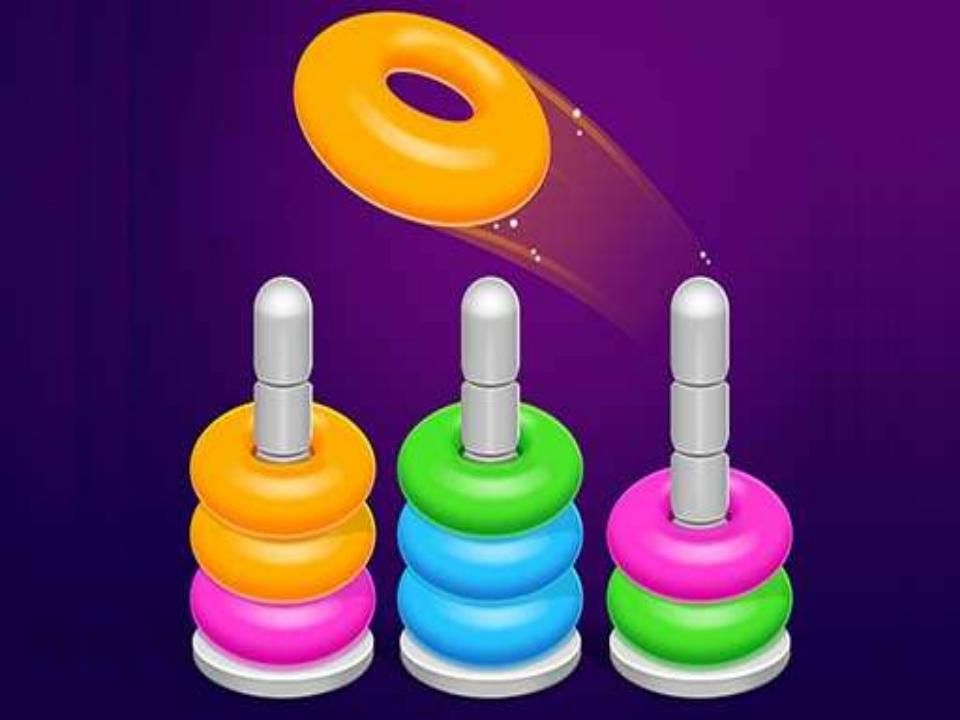
Game Introduction Step into the bright, lively world of Color Hoop: Sort Puzzle Game—your new favorite spot to flex color-sorting skills and puzzle-solving cleverness! Dive into a space filled with vibrant hues, where stacks of colorful hoops wait for you to tidy them up. Every level is a fun little challenge: all you need to do is sort those mixed-up hoops into neat, same-color piles, turning chaos into order with just a tap and drag.The game’s vivid visuals make every hoop pop, and the smooth, easy-to-learn gameplay pulls you in right away. Whether you’re squeezing in a quick round during a break or settling in for a longer play session, this addictive puzzle will keep you focused and entertained for hours. It’s not just about sorting—it’s about the satisfying rush of nailing each level, one colorful hoop at a time. Game Features 1. Simple Gameplay with Zero Learning CurveNo complex tutorials are needed—you only need to "tap and drag" to play. Just sort hoops of different colors into piles of the corresponding color. Both new and experienced players can get started quickly and dive into the game easily. 2. Vivid Visuals & Healing Color PaletteThe game uses bright, high-saturation color design. Each hoop has distinct colors and stands out visually, paired with a clean and simple interface. It not only catches players' attention but also delivers a comfortable, visually healing experience. 3. Perfect for Fragmented Time, Adaptable to Various ScenariosEach level takes a short time to complete. Whether you’re on your commute, during a lunch break, or relaxing before bed, you can start a round quickly. It makes good use of fragmented time to kill boredom without the burden of long play sessions. 4. Rewarding Progression, Balancing Fun & ChallengeAs you advance through levels, the number of hoops and color combinations gradually increase. From easy sorting in the early stages to strategic planning later on, you’ll gain a sense of satisfaction from "organizing chaos" after completing each level, making the game balance casual fun with moderate challenge. Gameplay and Controls I. Core Operations (3 Steps to Clear the Level)The whole process only requires "tap + drag", with steps as follows:1. Select a Hoop: Tap and hold the hoop at the top of any column (some versions have a highlight prompt).2. Find the Target Column: Drag the hoop to the top of the target column, which must meet two conditions: ① The top hoop of the target column is the same color; ② The column is not full (there is a full-column prompt).3. Place the Hoop: Release your finger/mouse to complete the placement. Repeat until each column has hoops of only one color to clear the level.II. Efficient TipsEssential for high-difficulty levels:- Prioritize completing columns with a single color to reduce interference.- Use empty columns to temporarily store hoops and free up space flexibly.- Observe the color distribution at the start and plan before operating.III. Special Notes- When stuck in a dead end, click the circular arrow icon in the upper right corner to reset the level. Game Guide Color Hoop: Sort Puzzle has become a hit in casual puzzle games with its "ultra-simple operation + progressive challenges". Behind the seemingly straightforward color sorting lies key logic to improve efficiency. Master the following strategy points, and players from beginners to advanced levels can clear levels easily while developing a "see-through-at-a-glance" sorting mindset. The core of the beginner stage (Levels 1-20) is to establish a "priority mindset". At this stage, there are only 3-4 color types and sufficient columns, so no over-planning is needed, but it's essential to develop a good habit: prioritize handling "initial single-color columns". If a column has only one color at the start, immediately gather all same-color hoops from other columns here to quickly clear a column as a "temporary transfer area". For example, when encountering red, blue, and yellow hoops, first move all red hoops to the initial red column. The emptied column can temporarily store blue and yellow hoops to be sorted, avoiding confusion caused by repeated movements. Familiarize yourself with the operation feel at this stage, and pay attention to the "adsorption judgment" when dragging hoops—align the top with the target column before releasing to reduce mistakes. In the mid-stage (Levels 21-60), the number of colors increases to 5-6, and some levels feature the difficulty of "no empty columns initially". At this point, the "transfer strategy" is crucial. When all columns have mixed hoops, first observe which color has the smallest quantity and focus on clearing a dedicated column for it. For instance, if there are only 3 purple hoops distributed across three different columns, you can first move the purple hoops from two columns to the third. After forming an exclusive purple column, this column becomes a stable "color anchor", and you can sort other colors based on it. Meanwhile, make good use of "pre-judgment and space reservation": if a color has more than 5 hoops, reserve an empty column in advance to exclusively accommodate them, avoiding the predicament of being unable to place hoops due to full columns later. The core of the advanced stage (Level 61 and above) is "reverse planning + deadlock breaking". At this stage, there are up to 7-8 colors, but the number of columns does not increase correspondingly, often leading to the risk of "multi-color cross-stacking" deadlocks. Spend 3 seconds scanning the entire screen before starting. Use the "color counting method" to mark the quantity of each color and prioritize handling the color with the largest quantity—such hoops are widely distributed, and gathering them early can greatly reduce cross-interference. If stuck in a deadlock (e.g., Column A has a red hoop on top, Column B has a blue one, Column C has a yellow one, and none can be moved to each other), immediately check for overlooked "lower-level hoops": after dragging the top hoop of a column, there may be other connectable colors underneath. For example, after dragging the red hoop from Column A, a blue hoop is revealed below, which can be moved to Column B to unlock the situation. In terms of general skills, "speed control" and "cautious use of props" are also key. Keep steady when dragging hoops to avoid accidentally touching other columns; the "hint props" in some versions are recommended to be saved for advanced levels. Relying on your own planning can better enhance the gaming experience. Finally, remember: the core logic of each level is to "reduce variables". By establishing dedicated columns and reserving transfer areas, you can convert complex multi-color mixing into simple single-color sorting, making level clearance a natural outcome.
